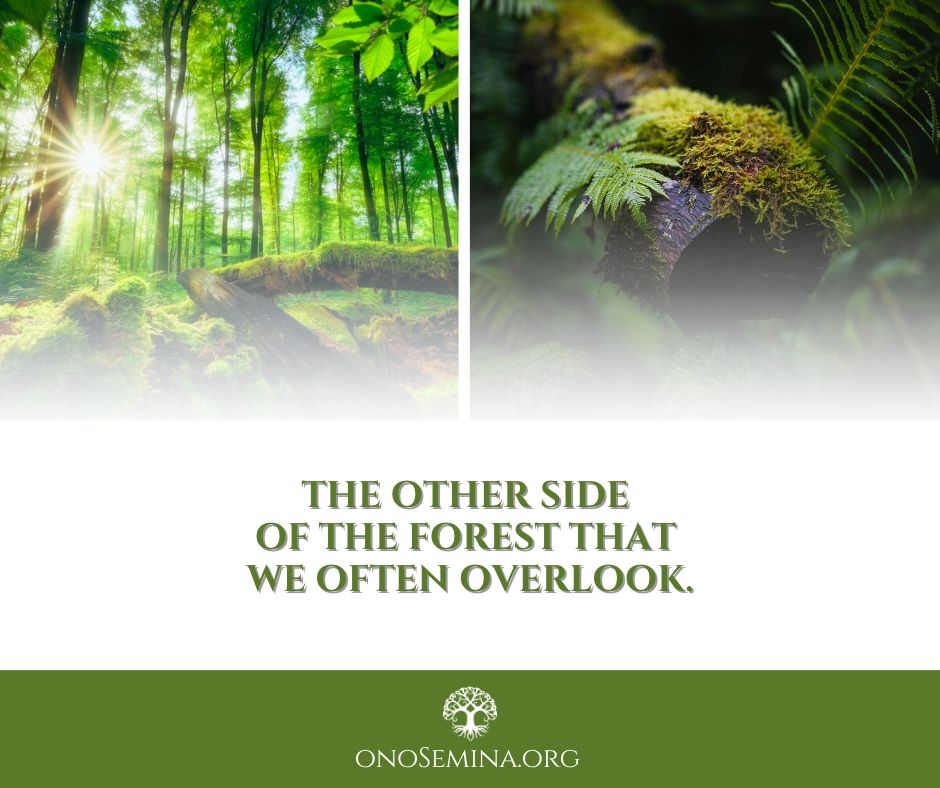
When we think of a forest, we picture green treetops, birdsong, fresh air and tranquillity. However, when we look a little closer, we discover that life in the forest also continues in places where everything appears to have come to an end. On the forest floor, among leaves, mosses and damp leaf litter, lie trunks, fallen branches and twigs that have stopped growing but still play an essential role in the entire ecosystem.
Deadwood is one of the most important elements of a natural forest. Although it no longer produces new leaves or reaches towards the light, it becomes a habitat for new generations of organisms. Hidden within it is a world of fungi, bacteria, insects, mosses and many other forms of life. Here, decomposition does not mean the end. It is part of the continuous cycle of matter that allows the forest to replenish its resources and preserve its biological richness.
Why is deadwood so important for the forest?
In natural forest ecosystems, trees die for various reasons. They reach the end of their life cycle, are brought down by the wind, damaged by snow or affected by natural diseases. Their remains stay in the forest and gradually become part of its biological structure.
Fallen trunks, broken branches, decaying sections of trees and standing dead trees create a habitat that cannot be replaced simply by the presence of living plants. They provide shelter, food and places for many species to develop. Processes taking place inside them influence soil fertility, moisture retention and the functioning of the entire ecosystem.
Deadwood is also an important indicator of how natural a forest is. In managed forests, the amount of deadwood is often reduced by removing dead trees and branches. However, in many ecosystems, leaving sufficient quantities of deadwood helps preserve habitats essential for organisms that depend on old and decaying trees.

The invisible inhabitants of deadwood
Fungi are among the most important organisms associated with deadwood. They are responsible for breaking down the complex substances that make up wood, including cellulose and lignin. Through their activity, a hard tree trunk gradually softens, changes its structure and turns into material that can be used by other organisms.
Fungal fruiting bodies appear on the surface of trunks, while an extensive network of mycelium develops inside the wood. Together with bacteria, fungi help release nutrients and return them to the natural cycle.
Deadwood is also home to numerous invertebrates. Beetles, insect larvae, ants and other small organisms live in it, finding both food and safe conditions for their development. Particularly important are saproxylic insects – species associated with dead and dying wood. Many of them depend on specific tree species, suitable moisture levels and particular stages of decomposition. This is why preserving different types and stages of deadwood is so important for their survival.
But life in a dead tree does not end with these tiny inhabitants. Insects and their larvae provide food for birds, amphibians, reptiles and small mammals. Woodpeckers search for food beneath the bark and inside decaying sections of trunks, while cavities in old and dead trees can also provide nesting sites and shelter for other species.
It is an extraordinary relationship: a single dead trunk can support an entire network of organisms that interact with one another.
A natural reservoir of water and nutrients
Deadwood also plays an important role in the forest’s water cycle. Its porous, gradually decomposing structure can absorb and retain water, creating a moist environment that is particularly valuable during periods of low rainfall. This benefits the organisms living in the wood as well as the surrounding soil.
Fallen logs, branches and root fragments influence the structure of the forest floor. On sloping ground, they can slow down water runoff and help limit erosion, while their gradual decomposition enriches the soil with organic matter.
Wood contains carbon compounds and minerals accumulated over many years. As decomposition progresses, some of these resources are released and reused by other organisms. In this way, the material that once formed the tree trunk becomes part of new biological processes.
Deadwood therefore helps maintain soil fertility, regulate moisture and preserve the ecological balance of the forest.
Dead trunks as nurseries for a new forest
One of the most remarkable phenomena found in natural forests is the regeneration of trees on decaying trunks.
Moist, softened wood can provide a suitable surface for germinating seeds and young seedlings. Young spruces, firs and other tree species can grow in these conditions, depending on the type of forest.
Fallen trunks can give young plants access to light, reduce competition from ground vegetation and create favourable conditions for root development. As the wood continues to decompose, the young tree grows and becomes part of the next generation of the forest.
In this way, an old tree becomes the foundation for new life. Its material, structure and place within the ecosystem help create the conditions needed for future generations of plants.
It is one of nature’s most beautiful examples of continuity, where every stage of life contributes to the next.
Why does removing deadwood threaten biodiversity?
We have become accustomed to seeing a tidy forest as a place where all dry branches, broken limbs and dead trees should be removed. However, this idea of tidiness does not always reflect what nature needs.
Intensive deadwood removal reduces the availability of habitats for many species of fungi, insects and other organisms. Particularly vulnerable are specialised species that depend on a specific type of wood, its size, the tree species or its stage of decomposition.
It is important to remember that both the quantity and diversity of deadwood matter. Standing dead trees, large fallen trunks, small branches and decaying stumps each create different living conditions. Every one of these elements can be important to different forest inhabitants.
Protecting deadwood is therefore an important part of preserving natural processes and biological diversity.
Of course, this does not mean that every dead tree should be left in any location. Near roads, paths and buildings, safety must be assessed responsibly. However, it is essential to retain sufficient quantities of deadwood in places where it can safely fulfil its ecological functions.
How can we support the life hidden in deadwood?
Protecting biodiversity begins with understanding that a forest is a complex system of interconnected relationships. Even elements that may seem unnecessary at first glance can play an essential role in its functioning.
We can also support organisms associated with deadwood in our everyday lives:
- Leave naturally fallen branches and pieces of wood in suitable areas of the garden.
- Preserve old trees wherever their condition and location allow them to remain safely.
- Create small piles of branches that can provide shelter for insects and small animals.
- When walking in the forest, observe natural processes and teach children to recognise its smaller inhabitants.
- Support initiatives that protect native ecosystems, old-growth woodland and areas of high natural value.
Every one of these actions helps preserve habitats for organisms whose presence is essential to the health and balance of ecosystems.

Together, let’s protect the future of natural ecosystems
Deadwood shows us just how important every element of nature is, including those we often overlook. Protecting forests means caring for entire ecosystems, their inhabitants, natural processes and the spaces where future generations of plants and animals can thrive in their natural environment.
This is why onoSemina was established – an association dedicated to supporting the protection and restoration of nature, native ecosystems, forests, flora and fauna. We engage in initiatives aimed at restoring degraded areas, support projects focused on woodland restoration and work towards the long-term protection of places of natural value.
Making these efforts possible requires commitment, cooperation and financial resources. Every donation to onoSemina helps us support further environmental initiatives, develop nature conservation projects and take action to preserve our natural heritage.
Your support matters. You can help us through a one-off donation, regular financial contributions or by joining the association as a member. Every form of involvement strengthens our ability to act and allows us to support more projects that need help.
By supporting onoSemina, you become part of a community of people who care about the future of nature. It is a shared responsibility for forests, natural habitats, biodiversity and the world we will leave to future generations.
Nature needs people who take action
Join onoSemina
Support forest conservation, the restoration of native ecosystems and initiatives that protect biodiversity. Together, we can do more for the future of our planet.
Support our work and help us protect nature.
Here are the GBP bank account details for onoSemina, held with Wise.
If you are sending money from a UK bank account, you can use these details to make a domestic bank transfer. If you are sending money from outside the UK, please use an international SWIFT transfer.
Account name: onoSemina
UK domestic transfers:
- Account number: 80311613
- Sort code: 23-14-70
International transfers:
- IBAN: GB07 TRWI 2314 7080 3116 13
- SWIFT/BIC: TRWIGB2LXXX
Bank name and address:
Wise Payments Limited
1st Floor, Worship Square
65 Clifton Street
London, EC2A 4JE
United Kingdom